Ask a structural steel fabricator which welding code their shop lives under, and the answer is almost always AWS D1.1, the Structural Welding Code for Steel. It is the most widely used welding code in American construction and manufacturing, and it is the code behind most of the welder testing Fusion Pro performs across Wisconsin.
If your shop is about to take on a job that requires D1.1 qualified welders, here is what the qualification process actually involves.
What AWS D1.1 Actually Governs
D1.1 covers the welding of structural steel. Within it you will find requirements for welding procedures (WPS and PQR documentation), welder performance qualification, fabrication and inspection requirements, and acceptance criteria for welds.
That distinction matters: a welder qualification under D1.1 demonstrates that the individual can produce acceptable welds under a defined set of conditions. It does not by itself authorize any welding, on any joint, in any position.
What a D1.1 Welder Qualification Test Involves
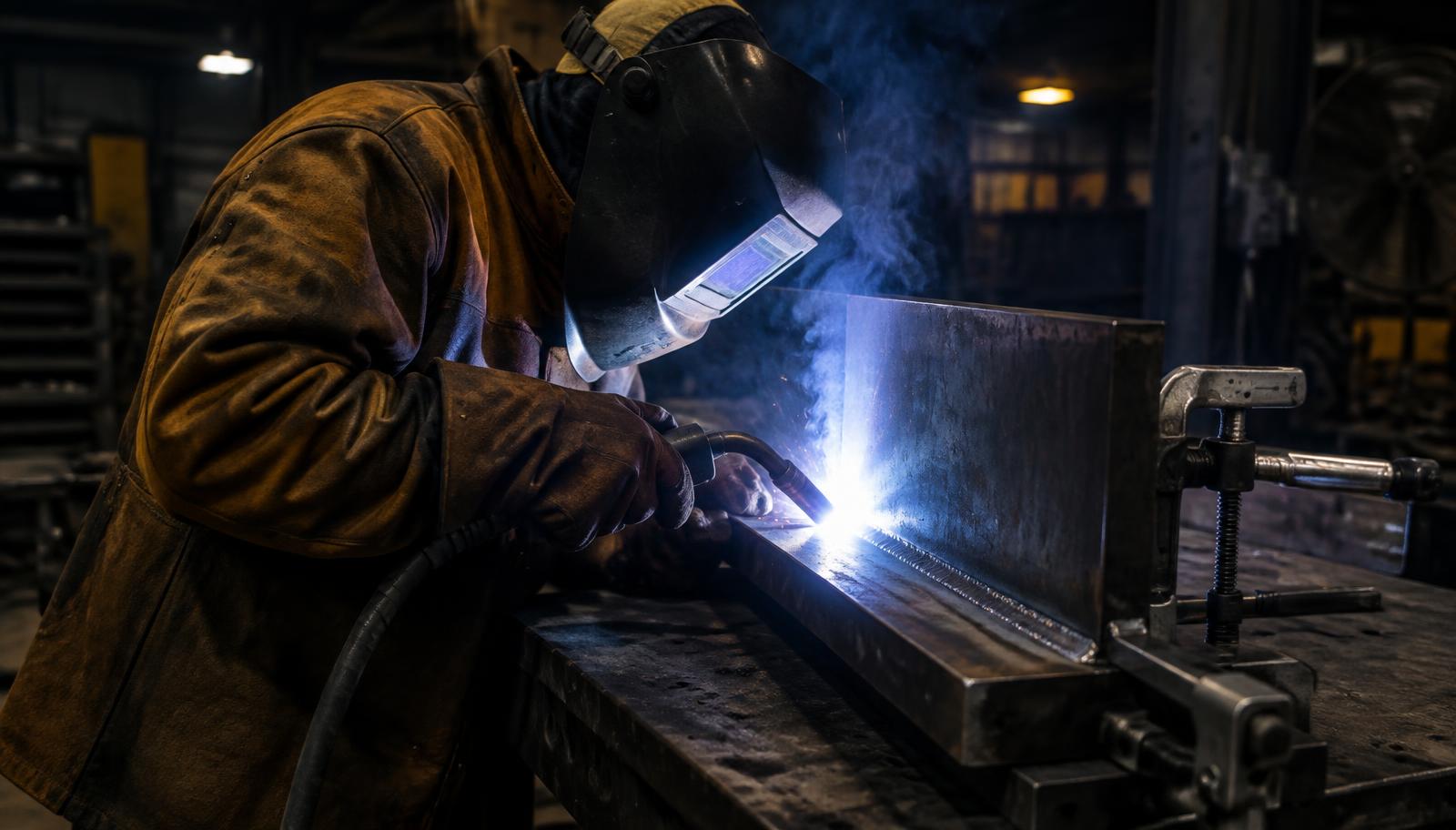
The most common route is a plate groove weld test. The welder produces a test coupon in a specified position using the process, material, and setup the employer needs documented. The completed coupon is examined visually and, in the typical groove weld test, subjected to bend tests to check soundness.
Before the test, a few details should be confirmed, because each one shapes what the resulting qualification covers:
- The welding process (SMAW, GMAW, FCAW, GTAW, SAW, or another process)
- The test position (flat, horizontal, vertical, or overhead)
- Whether the test is with or without backing
- The base metal and filler metal combinations
- The welding direction for vertical tests (uphill or downhill)
Positions and What They Cover
For plate work, the common groove weld test positions are:
- 1G: flat position, plate lying flat, welding from above
- 2G: horizontal position, vertical plate welded from the side
- 3G: vertical position, plate vertical, welded vertically (uphill or downhill)
- 4G: overhead position, plate overhead, welding from below
Each test position qualifies the welder for a defined range of production positions, and the code spells out those ranges in its tables. Testing in a harder position, such as 3G or 4G, generally broadens what the qualification covers, which is why many employers choose those tests even when their production work is mostly flat and horizontal.
Essential Variables: Why a New Job Can Mean a New Test
A D1.1 welder qualification is tied to essential variables such as the welding process, the position and welding direction, backing, and other conditions defined in the code. If the production work changes in a way that exceeds the qualification, the welder may need to requalify for the new conditions.
That is not a formality. It is what lets a customer or inspector look at a welder's record and know exactly what that welder has demonstrated.
Records and Continuity
The qualification record is a document for the employer, not a pocket card for the welder. It should state the welder's name, the test conditions, the results, and the range of qualification.
Continuity also matters. For the AWS Certified Welder program, AWS states that certification remains active when the required continuity is maintained, including documentation of continued use of the process at six-month intervals. Employer, code, and project requirements can differ, so the applicable rules for your qualification should always be followed.
D1.1 Testing at Your Shop
Fusion Pro Test Training performs AWS D1.1 welder qualification testing on site at shops and job sites within roughly 100 miles of Brookfield. Testing is scheduled around production, coupons are evaluated to the code, and signed qualification records go to the employer, with digital copies and guidance on continuity tracking.
Send the process, position, material, and number of welders, and you will get a firm plan and a straight quote for the testing.
Need a CWI on your floor?
Send us the code, welding process, position, material, location, and number of welders - we'll scope the visit and get your crew qualified on site.