Job postings and welder resumes are full of shorthand: 3G certified, 6G pipe, 4G overhead. If you are hiring welders or arranging qualification testing, it helps to know what those labels actually mean, because the position a welder tests in determines what that welder is qualified to do in production.
First, the Letters: F and G
In the welder qualification systems used by AWS and similar codes, F stands for fillet welding and G stands for groove welding. A test described as 3G is a groove weld test in the vertical position, while 3F is a fillet weld test in the same position.
Groove weld tests generally carry the broadest production coverage, which is why they are the most common choice when employers want a qualification that will hold up across a range of work.
Plate Positions: 1G Through 4G
- 1G: flat. The plate lies flat and the weld is deposited from above. The easiest position and the narrowest qualification.
- 2G: horizontal. The plate stands vertical and the weld runs horizontally across it. Gravity pulls the puddle sideways, which makes this harder than it sounds.
- 3G: vertical. The plate stands vertical and the weld runs up or down the plate. Welding direction (uphill or downhill) matters for the qualification.
- 4G: overhead. The plate is overhead and the weld is made from below, with spatter and molten metal working against the welder.
A welder who passes a 3G or 4G groove weld test typically qualifies for the easier positions as well, within the ranges the code defines. That is why 3G and 4G are the workhorse tests for structural steel shops.
Pipe Positions: 5G, 6G, and 6GR
Pipe adds rotation and restricted access to the picture:
- 1G (pipe): the pipe is rolled, so the welder stays essentially in the flat position while the pipe turns.
- 2G: the pipe stands on end (axis vertical) and the weld runs horizontally around it.
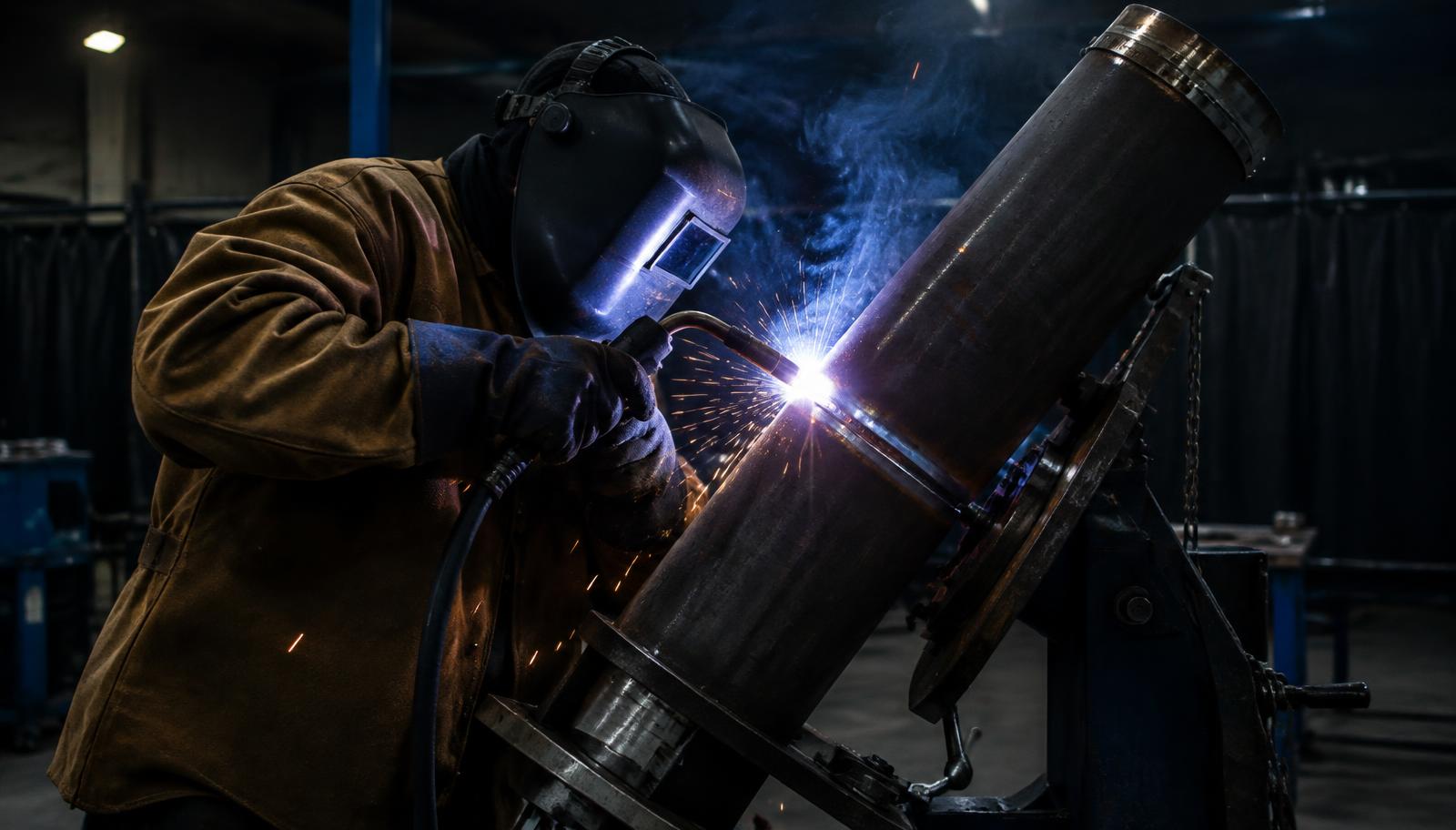
- 5G: the pipe is fixed with its axis horizontal. The welder moves around the pipe through flat, vertical, and overhead positions on the same joint.
- 6G: the pipe is fixed at roughly 45 degrees, inclined, and cannot be rolled. The welder works through every position on one joint, which is why 6G is the standard badge of a pipe welder.
- 6GR: a restricted 6G test using a joint with obstructed access, meant to simulate the tight conditions found on structural connections such as T, Y, and K joints.
For work governed by API 1104, such as cross-country pipeline welding, the qualification tests and acceptance criteria follow that code rather than D1.1, but the same position logic applies.
What Your Qualification Actually Covers
Passing a test in one position does not automatically cover every position. Qualification records list a range of positions, along with limits for the process, joint type, backing, and sometimes pipe diameter, all defined by the code's qualification tables.
The practical takeaway for employers: match the test position to the production work, then check the range of qualification on the record before assigning the welder to a job. If the record does not clearly cover the work, the welder needs a different or additional test.
Choosing a Test Position for Your Shop
A simple rule of thumb: qualify welders in the position that matches (or slightly exceeds) the hardest work they will do in production. Testing in a harder position costs the welder more effort on test day but buys broader coverage and fewer retests later.
Fusion Pro performs welder qualification testing in all standard plate and pipe positions, on site at shops and job sites within roughly 100 miles of Brookfield. Tell us the code, process, and the positions your production work demands, and we will set up the right tests and put signed records in your hands.
Need a CWI on your floor?
Send us the code, welding process, position, material, location, and number of welders - we'll scope the visit and get your crew qualified on site.